






As the manufacturing industry transforms toward intelligence and precision, the spraying process, as a core step determining product appearance, texture and protection performance, directly influences an enterprise’s market competitiveness. Traditional manual spraying and outdated spraying equipment have long suffered from low efficiency, unstable quality and serious material waste. The popularization and application of robot spraying production lines are breaking industry bottlenecks through technological innovation, achieving a dual improvement in production efficiency and quality control, and becoming an important driver for quality and efficiency enhancement in manufacturing.
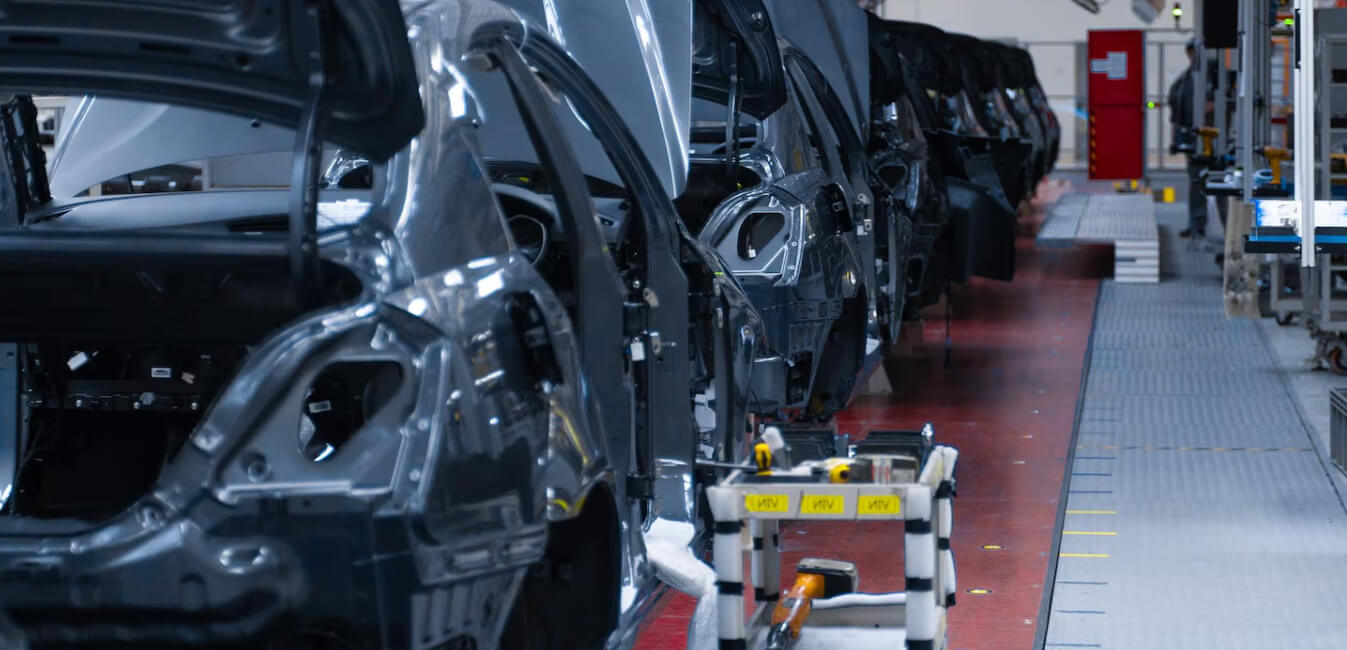
The core advantages of robot spraying production lines first lie in the all-round improvement of production efficiency, completely breaking away from labor dependence and process limitations of traditional models. Compared with manual spraying, industrial robots can operate continuously 24 hours a day without rest or shift rotation, effectively eliminating efficiency drops caused by operator fatigue. Meanwhile, the repeat positioning accuracy of six-axis industrial robots reaches ±0.03–0.05 mm. Combined with offline programming software to plan spraying paths in advance, invalid time spent on on-site debugging is avoided, greatly shortening production cycles. After introducing robots to a spraying line for construction machinery parts, single-shift output increased from 200 pieces manually to 600 pieces, representing a 200% efficiency improvement.
The integrated application of intelligent collaborative systems further amplifies efficiency advantages. Intelligent conveying lines adopt variable frequency speed regulation, precisely synchronizing with robot spraying cycles to achieve continuous workpiece flow and reduce downtime waiting. AGVs are deeply integrated with the MES manufacturing execution system, delivering coating materials on schedule according to production plans and dynamically adjusting conveying rhythms, building an unmanned full-process production model with seamless connection between logistics and spraying. In addition, breakthroughs in quick color change and quick model change technologies have reduced model change time from 4–8 hours for traditional equipment to within 30 minutes, and even color switching can be completed in 5 minutes. This perfectly adapts to the multi-variety, small-batch production demands of industries such as automotive and 3C, greatly improving line flexibility and equipment utilization.
In terms of quality control, robot spraying production lines have transformed the extensive experience-driven mode of traditional spraying through precise control and full-process closed-loop management, achieving a shift from rework and repainting to first-pass yield. High-precision atomizers mounted on robots enable fine coating atomization with droplet diameters below 50 μm. Combined with real-time flow feedback and closed-loop control systems, coating thickness errors are controlled within ±5 μm, effectively eliminating common defects such as missing spraying, sagging, pinholes and color differences. In automotive component spraying applications, Elite collaborative robots have increased the pass rate from 85% for manual work to over 99.8%, with the rework rate nearly reduced to zero.
The deep integration of digital technology provides full-process guarantee for quality control. The MES system collects key parameters in real time, including robot operating status, coating consumption and workpiece temperature, generating dynamic data reports. When parameters deviate from set ranges, the system automatically alarms and adjusts to avoid batch defects. One home appliance spraying line reduced parameter abnormality rates to 0.5% using this system. Equipped with high-resolution industrial cameras and deep learning algorithms, online AI visual inspection systems can inspect 10 workpieces per second, identifying tiny defects as small as 0.1 mm with an accuracy rate exceeding 99%. Inspection results are fed directly to the robot control system, forming a closed-loop optimization of inspection, analysis and adjustment. Meanwhile, a digital quality profile is established for each product, enabling full-process traceability.
Beyond dual improvements in efficiency and quality, robot spraying production lines also achieve coordinated development of cost optimization and green production. The combined use of electrostatic coatings and high-solid coatings increases coating utilization from 30–40% in traditional air spraying to over 80%, and even 98.6% in some scenarios, significantly reducing material waste. The application of energy-saving modes and variable frequency paint supply systems reduces energy consumption by more than 15%, cuts single-piece spraying costs by 20–30%, and shortens the return on investment period to 6–12 months. Meanwhile, the fully enclosed protective design of robots (IP66/IP68 rating) adapts to harsh workshop environments with high humidity and dust, reducing equipment failure rates and maintenance costs. It also effectively reduces harm to human bodies from toxic gases emitted by coatings, balancing safe production and environmental compliance, and helping enterprises transform toward green intelligent manufacturing.