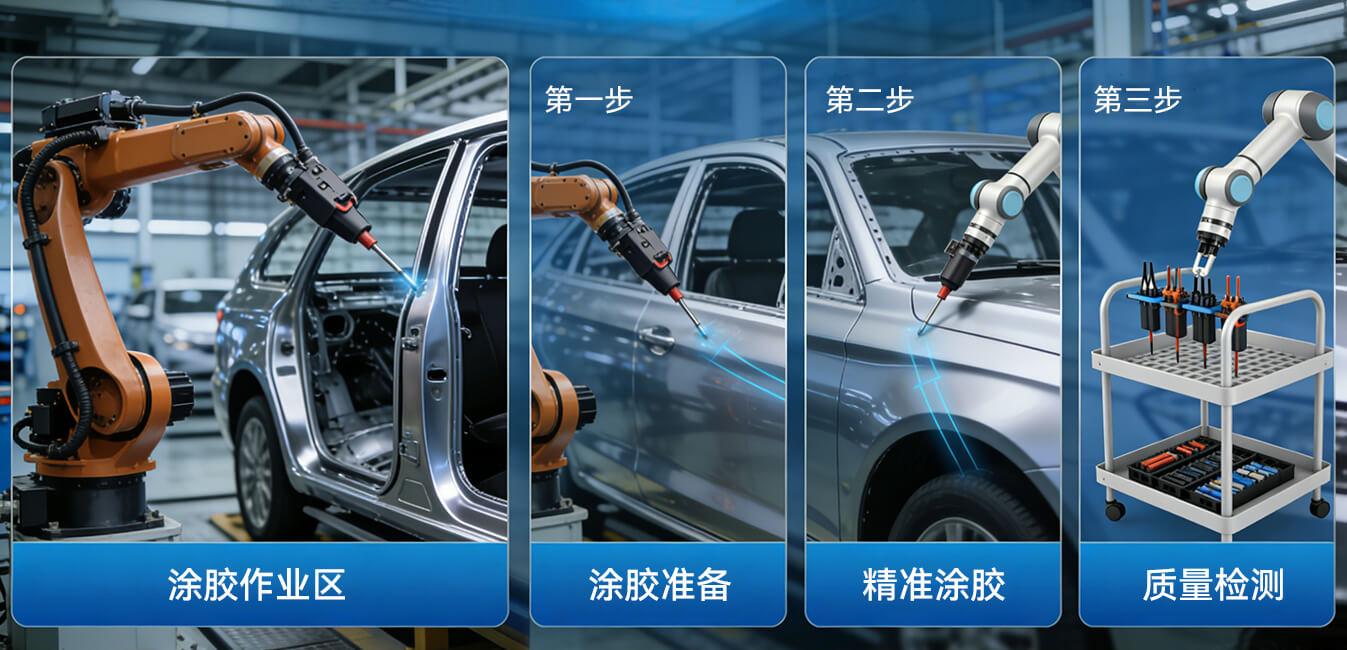






Against the backdrop of intelligent upgrading in manufacturing, the glue dispensing process is critical to product sealing, structural strength and assembly accuracy, and is widely used in automotive, electronics, new energy and other industries. Traditional manual glue dispensing is prone to issues such as uneven adhesive application, missed coating and excess adhesive overflow. It also suffers from low efficiency and severe material waste. The application of industrial robots is enabling quality improvement, efficiency enhancement and standardized production in the glue dispensing process.
The core advantage of robotic glue dispensing lies in its precision and controllability. Equipped with high-precision servo systems and visual positioning technology, it achieves a repeat positioning accuracy of ±0.02 mm. Paired with closed-loop flow control, it can precisely regulate adhesive volume and bead width, with adhesive weight error controlled within ±0.01 g, completely eliminating problems such as missed coating and overflow. It is especially suitable for hard-to-operate scenarios such as special-shaped curved surfaces and complex joints, greatly improving the consistency and reliability of glue dispensing.
High efficiency and flexible production represent another major highlight. Robots can operate continuously 24/7, with a working efficiency equivalent to 3–5 workers, significantly shortening production cycles. Meanwhile, through offline programming and quick changeover technology, process switching for different products can be completed within minutes, perfectly adapting to multi-variety, small-batch production demands.
The integration of intelligent technologies has made glue dispensing smarter. The incorporation of 3D visual inspection, MES systems and other technologies enables real-time monitoring, dynamic adjustment and quality traceability throughout the dispensing process. For instance, 3D glue dispensing quality inspection systems can accurately identify micron-level defects, provide real-time feedback for parameter adjustment, and form a full-process closed-loop optimization to reduce mass defects.
In industrial applications, robotic glue dispensing has penetrated multiple sectors. In the automotive industry, it is used for body sealing and power battery packaging, boosting both assembly quality and efficiency. In the electronics sector, it ensures stable bonding of precision components such as PCB boards and chips. In the new energy industry, it meets the high-precision requirements of power battery packaging while promoting the domestic substitution of core equipment.
In addition, robotic glue dispensing optimizes costs and ensures safety. Precise dispensing raises adhesive utilization from 60% to over 95%, drastically reducing waste. Automated operation replaces manual labor, lowering labor and quality risks. It also prevents operators from exposure to harmful substances, complying with safe production and environmental protection regulations.